|
|
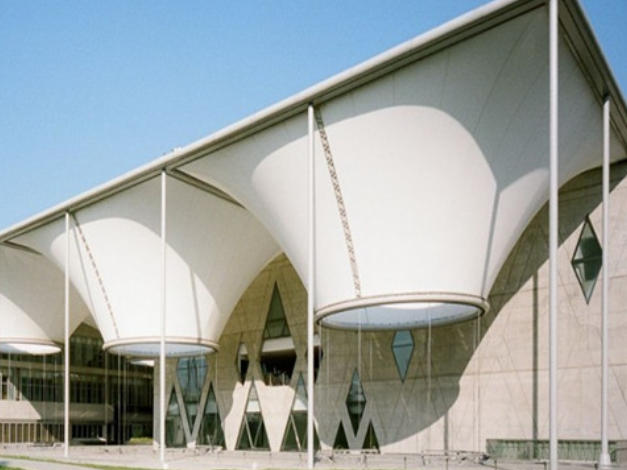
Commercial facility membrane structure
The core material of membrane structures is composite membrane fabric made from polyester fiber substrates or glass fiber coated with polytetrafluoroethylene (PTFE). It features lightweight properties (only 1/30 of traditional building materials), high light transmittance (5%-20%), and strong weather resistance (UV-resistant, corrosion-resistant). The structure is supported by steel cables or frameworks, forming a prestressed system that stabilizes the membrane surface under stress. This enables it to withstand winds exceeding Level 12 while dispersing loads through elastic deformation, preventing overall failure caused by localized damage. This "flexible yet robust" characteristic makes it outperform rigid structures under sudden loads like earthquakes.
Application Scenarios and Functional Implementation:
The flexibility of membrane structures in commercial facilities is reflected in three key scenarios: First, large-span coverage, such as mall atriums or parking lot canopies, with single spans exceeding 200 meters, eliminates the need for internal pillars, maximizing space utilization. Second, freeform designs-achieved through computer-aided design (CAD) and building information modeling (BIM) technologies-enable complex shapes like wave or dome configurations, enhancing commercial branding. Third, functional integration allows membranes to embed photovoltaic panels for power generation or adjust light transmittance via coatings, balancing shading and natural lighting needs. For example, some commercial complexes adopt double-layer membranes: the inner light-transmitting layer introduces daylight, while the outer reflective layer reduces heat radiation, cutting air conditioning energy consumption by over 30%.
Technical Support and Construction Key Points:
The reliability of membrane structures depends on three technical aspects: First, material development employs high-strength fibers and anti-aging coatings, ensuring a service life exceeding 25 years. Second, precision cutting unfolds curved surfaces into planar membrane pieces via 3D modeling, with errors controlled within 0.5% to avoid installation wrinkles. Third, tensioning processes use specialized equipment to apply prestress point by point, forming stable shapes like hyperbolic paraboloids to prevent water pooling or wind-induced vibrations. In terms of construction timelines, small projects (e.g., 500 m² canopies) can be completed in 7 days, while large venues (e.g., 20,000 m² stadiums) require only 3 months-reducing traditional construction periods by over 50%.
|
 ahyx@ahyx158.com